Choose by the job you need done
Buy a patio repeller first if your main goal is to enjoy one outdoor seating area. Consider a mosquito trap first only if you have space for its proper placement and can keep up a longer yard-control routine. A trap is a bigger commitment than a device you switch on before dinner.
For a calm, open patio used on long evenings, our premium pick is the Thermacell Patio Max. For a windy deck, a bedroom, or people walking around the yard, start with a different plan. The right choice may be screens or skin repellent.
A repeller puts repellent into the air around people. A trap draws mosquitoes toward a capture point. One aims to protect the spot you are using; the other aims to remove mosquitoes over time. Neither fixes standing water, and neither creates a sealed wall around a property.
Sources: Biogents: how the Mosquitaire works · AMCA: mosquito traps and their limits
Affiliate disclosure: As an Amazon Associate, we earn from qualifying purchases. This does not change your price.
The differences that matter before checkout
| Buying question | Patio repeller | Mosquito trap |
|---|---|---|
| What am I buying it for? | An occupied outdoor spot | Ongoing capture around a suitable yard site |
| When do I run it? | Before and during use of the area | Often continuously, as its manual directs |
| Where does it go? | Near the seating area, placed as labeled | Away from people, at the recommended trap location |
| What keeps costing money? | Repellent refills; power or fuel | Lures, capture supplies, power, and sometimes gas |
| What can spoil the purchase? | Wind, empty refill, flat battery, or a poor layout | Poor siting, blocked airflow, missing supplies, or incoming mosquitoes |
Repeller advantage: a small setup for occasional patio use. Tradeoff: you pay for occupied hours and must stay within the area it reaches.
Trap advantage: capture can continue while you are away from the patio. Tradeoff: it needs a good site, regular checks, and patience. A bag full of insects does not prove that your family received fewer bites.
Do not group every trap together. A UV flying-insect trap, a scent-and-fan mosquito trap, and an egg-laying trap do different jobs. Our zapper versus trap guide explains why a glowing light is not enough to make a mosquito-focused purchase.
Sources: AMCA: mosquito traps and their limits · Biogents: trap layout and operation · Mosquito Magnet: maintenance
Premium patio pick: Thermacell Patio Max
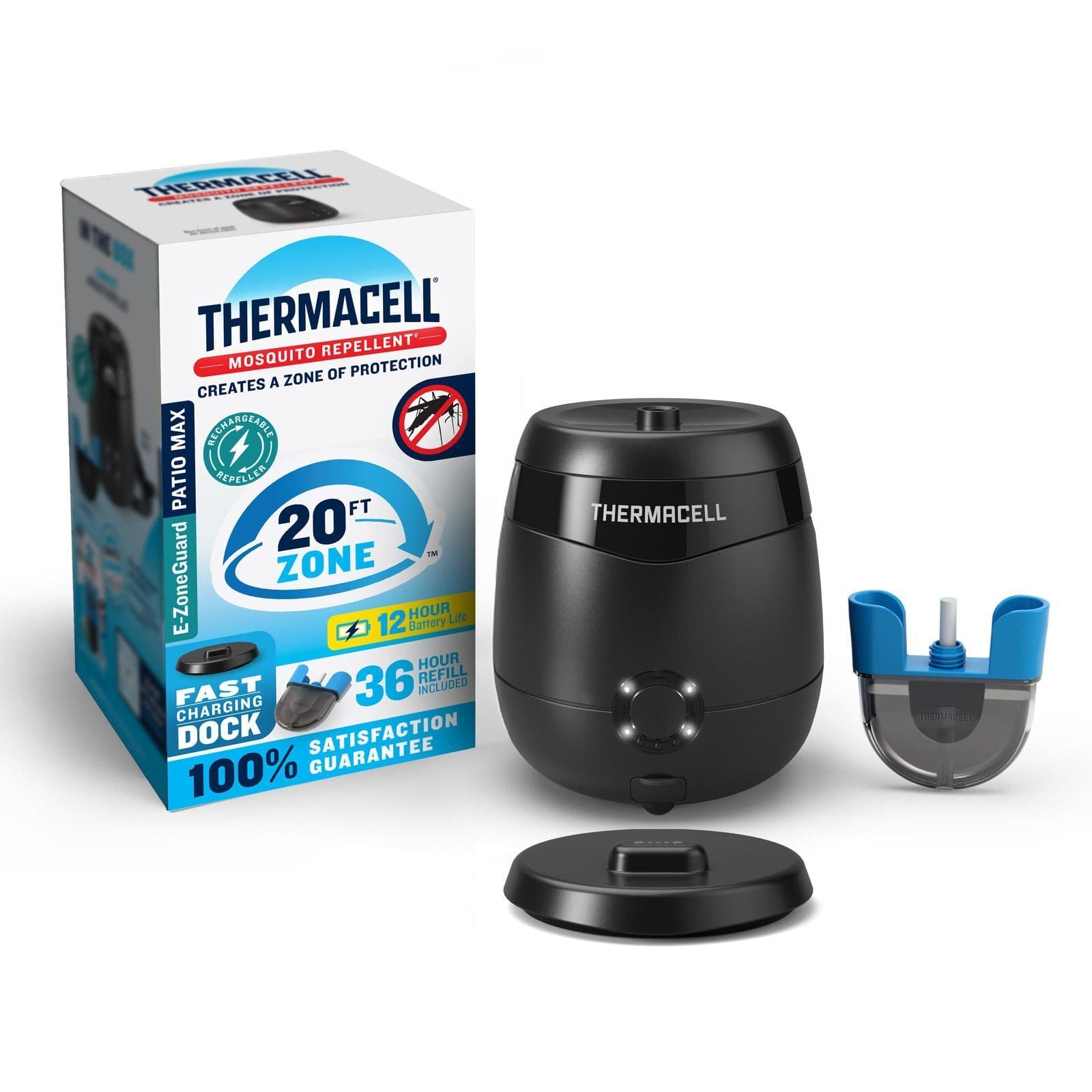
For long evenings at one seating area
The E-ZoneGuard Patio Max pairs a rechargeable repeller with a charging dock. The current black starter bundle lists a 36-hour repellent refill, up to 12 hours of battery operation, and a 20-foot zone. These are manufacturer specifications, not a promise for every weather condition.
Buy it for: longer outdoor dinners, reading on an open porch, or a regular table where you can follow the placement directions.
Skip it for: indoor rooms, enclosed tents, windy exposed decks, or whole-yard coverage. A larger battery does not create a larger protected yard.
Planning range: $50–$90 for the starter kit before tax and delivery. Budget for later refills separately.
Pros: long stated runtime, a charging dock, and no skin application. Cons: ongoing refill purchases, warm-up time, and weather limits.
Check that the selected Amazon variant includes the dock and the refill size you expect. Battery hours and refill hours are separate. Also check the seller’s return terms before opening the kit.
Sources: Thermacell: Patio Max specifications · Thermacell: rechargeable setup and refills
For the trap side of the comparison, the Biogents system overview explains a scent-and-fan format with a separate CO₂ option. Use it to understand the parts involved; this guide’s purchase pick is the patio repeller above. See our bottled CO₂ versus propane guide before committing to gas equipment.
Measure seats and trap space separately
A small patio is not a small version of an acre
Mark the chairs, not just the deck edges. The Patio Max’s stated 20-foot zone is a diameter: 20 feet across, or a 10-foot radius. That describes a circle, not a 20-by-20-foot square. Even seats inside that outline may be affected by wind or obstacles.
For a 12-by-12-foot patio, one compact seating cluster is a more sensible starting point than tables spread along the edges. For a 12-by-24-foot deck with two separate groups, assess each group. Do not assume the same device reaches both because the total floor area sounds small.
A quarter-acre yard can still lack a good trap site
Look for the placement your chosen trap needs, plus safe access for service. Biogents advises at least 15 feet between people and its outdoor traps. Mosquito Magnet commonly suggests 30–40 feet from human activity. These are model-family examples, not interchangeable rules.
If your yard is a narrow strip with chairs at one end and no spare shaded area, a large trap may be the wrong fit. A half-acre or acre lot also needs a layout check; trees, breeding sites, wind, and neighboring land matter more than a neat circle on a box.
Sources: Thermacell: Patio Max specifications · Biogents: trap layout and operation · Mosquito Magnet: trap placement
Budget for a season, not one box
These broad US-dollar ranges are planning allowances, not live prices or quotes. Tax and shipping are extra. Price the exact bundle and your local supplies before you buy.
| Plan | Initial allowance | Price next |
|---|---|---|
| Premium rechargeable patio kit | $50–$90 | Compatible refill cost per labeled hour |
| Outdoor scent-and-fan trap setup without gas | $200–$400 | Lures, catch bags, power, and replacement parts |
| Gas-assisted yard-trap setup | $400–$1,200+ | Included parts, cylinder or tank, first fill, later fills, and lures |
| Both a repeller and a trap | Add the two complete setups | Both supply routines; do not count included supplies twice |
Turn patio visits into refill hours
Suppose you sit outside for three hours, three evenings a week, for 12 weeks. That is 108 occupied hours. Add warm-up time on all 36 visits. With a hypothetical 15-minute warm-up, the total becomes 117 hours for one unit. Two units on that same schedule need 234 device-hours.
Use the refill’s labeled hours to work out the quantity, then subtract any usable supply included in your starter kit. This is a budget example, not a claim about battery life or an instruction to stretch a spent refill.
A trap can have costs on days you never go outside
Make a season checklist for lures, nets or bags, power, gas, and cleaning. For a powered trap, estimate electricity as watts ÷ 1,000 × running hours × your utility rate. Use the exact unit’s wattage. For gas, ask a local supplier about fills and cylinder charges before ordering the trap.
Mosquito Magnet’s upkeep guidance uses a 21-day routine for fuel and attractant changes during continuous operation. That is an example for its system, not a refill interval for every trap. Our repeller refill guide covers the other side of this budget.
Sources: Mosquito Magnet: maintenance
When buying both makes sense
Both can make sense when you use one patio often, have a separate trap site, and are willing to maintain two systems. Start with the tool that solves your most pressing problem. Add the other only when you know what gap remains.
This is a planning sketch, not a scale drawing. Do not put a trap beside the dinner plates just because the cord reaches. Keep the repellent zone away from the trap inlet. There is no single proven separation distance for every brand pairing; ask the trap maker if the available space is tight.
For a weekend cabin, think about who checks the trap between visits. For a party tomorrow, spend first on the occupied area and personal protection. For daily gardening around the lot, a stationary repeller cannot follow you. Compare skin repellent options.
Sources: Mosquito Magnet: trap placement
Check children, pets, weather, and enclosed spaces
DEET-free does not mean insecticide-free. Rechargeable Thermacell refills use metofluthrin. Follow the refill label and device instructions, keep supplies out of reach, and prevent children or pets from handling the unit. Never refill a cartridge with a homemade mix.
Use an outdoor repeller only outdoors. A closed tent, bedroom, garage, or enclosed porch does not become an outdoor use site because a door is open. For a bedroom, start with screens that seal the openings and indoor mosquito-control choices.
Plan a stable place for the repeller and safe routing for trap cords. Follow the exact instructions for rain, charging, fuel, and cylinders. Thermacell advises bringing rechargeable units in when severe weather is expected. “Outdoor” does not mean every part can sit in pooled water.
For ponds, hives, or a pet that chews equipment, check the exact environmental and handling precautions before buying. A trap without airborne repellent may meet a preference, but it still has parts and supplies to secure.
Sources: Thermacell: outdoor use, wind, and rain · Thermacell: ingredients and safety
An EPA establishment number on a trap is not proof that EPA reviewed its bite-prevention performance. EPA distinguishes such devices from registered pesticides. Read what the product actually claims and what the label allows.
Sources: EPA: what device registration means
Fix these problems before buying another device
- You still have standing water. Each week, empty and scrub, cover, or remove water-holding items. Use a site-labeled larvicide only where water cannot be removed. See Dunks versus Bits.
- The repeller is running but seats are exposed. Check the refill, charge, warm-up, wind, and placement before assuming you need a second unit.
- The trap catches very little. Check its power, airflow, lure, catch bag, and site. A poor spot will not improve just because the trap is more expensive.
- The trap catches plenty but people still get bitten. Incoming mosquitoes and nearby sources can keep the problem going. Catch count alone cannot settle whether to buy another trap.
Do not test success by leaving skin unprotected to count bites. Keep normal bite prevention in place and note whether the yard is easier to use over comparable visits. If biting remains severe, ask the local mosquito-control program about species and nearby sources.
Sources: CDC: mosquito control at home · AMCA: mosquito traps and their limits
For a breezy table, compare an outdoor-rated fan. For a fixed area where you want a physical barrier, compare a screen house. Where mosquito-borne illness is a concern, follow local public-health advice and use EPA-registered skin repellent as directed; a yard gadget is not a complete protection plan.
Sources: CDC: preventing mosquito bites
Buy the next useful layer
Choose a repeller for suitable occupied seating. Choose a trap when the yard, schedule, and upkeep fit. Use the product finder to compare those formats, then review the Thermacell model guide or yard-trap buying guide for your next decision.
Questions to settle before checkout
Is Thermacell a mosquito trap?
No. It releases repellent into the air around an outdoor area. It does not use a catch bag to remove mosquitoes from the yard.
Which should I buy for a patio dinner this weekend?
Start with a repeller if the seating area and weather suit its label. Allow warm-up time. A new yard trap is not a reliable last-minute plan for a dinner.
Does a trap protect a whole acre from bites?
An acreage claim is not a bite-free boundary. Layout, mosquito species, nearby breeding sites, placement, and upkeep all matter. Keep personal protection available.
Does a 20-foot repeller zone mean a 20-foot radius?
For the Patio Max, the stated zone is 20 feet across. That is a 10-foot radius under the stated conditions. Wind and obstacles can change the area reached.
Can I use a repeller and a trap together?
They can fill different roles in the same yard. Put the repeller at the occupied area and the trap at its own recommended site. Do not crowd both onto the same table.
Will the repeller stop my trap from working?
There is no universal separation distance for every pairing. Keep the repellent zone away from the trap inlet and follow both manuals. Ask the trap maker about a tight layout before buying both.
Where should I put a mosquito trap?
Use its model-specific placement guide. Biogents recommends at least 15 feet from people for its outdoor traps; Mosquito Magnet commonly suggests 30–40 feet. Those are different instructions, not one universal rule.
Can I turn the trap on only while I sit outside?
That can undermine a trap designed for continuous use. Check its operating schedule before buying. If you only want to run a device during occasional patio visits, a repeller may suit you better.
How long should I give a new trap?
Use the evaluation period in its manual and check placement and supplies during that time. Do not judge it from one evening or a single full bag. Confirm the seller’s return deadline before starting.
Which is cheaper to run?
It depends on your schedule. A repeller uses refills during occupied hours; a continuously running trap may use power, lures, and gas between visits. Compare the full season, not just the starter kit.
Does a 36-hour refill mean 36 hours on one battery charge?
No. Refill life and battery runtime are separate. The Patio Max listing specifies a 36-hour refill and up to 12 hours of battery operation. Recharging does not replace spent repellent.
Can I use the Patio Max in a bedroom or closed tent?
No. It is for outdoor use only, not enclosed spaces. Repair screens and use indoor measures suited to the room instead.
Is a DEET-free repeller free of insecticide?
No. Rechargeable Thermacell refills use metofluthrin. DEET-free describes the absence of one ingredient; it does not mean the device releases only warm air.
Is a trap automatically safer around pets?
No device is free of all hazards. Consider cords, hot parts, fuel or gas equipment, refill storage, and access by pets and children. Follow the exact label and manual.
Do I need a repeller if I already have a trap?
Only if you still need protection where you sit and the site suits a repeller. First check the trap setup and nearby water. Screens or labeled skin repellent may fill the gap better.
Does a full catch bag prove the trap is the better buy?
No. A catch bag shows capture, but does not measure how many bites people avoided. Judge the purchase by your goal, upkeep, and use of the yard, while keeping bite prevention in place.
Sources and further reading
- Thermacell: Patio Max specifications
- Thermacell: rechargeable setup and refills
- Thermacell: outdoor use, wind, and rain
- Thermacell: ingredients and safety
- Biogents: trap layout and operation
- Biogents: how the Mosquitaire works
- Mosquito Magnet: trap placement
- Mosquito Magnet: maintenance
- AMCA: mosquito traps and their limits
- EPA: what device registration means
- CDC: mosquito control at home
- CDC: preventing mosquito bites