Buy a trap for capture, then solve the entry problem
A fan-and-glue trap is the most practical trap style to consider for a bedroom if you can tolerate its light and fan. Start with one. Choose a model with replaceable boards, a low setting, and clear indoor-use directions. Skip the purchase if you need a dark, silent room or expect the device to stop every bite.
Before spending, check how mosquitoes get in. Repair screens, close doors, and check water in vases and plant saucers. CDC puts these steps first for indoor control. A trap cannot seal a gap or empty a container for you.
Use the product finder to compare indoor options with the rest of your mosquito plan. Keep outdoor and indoor jobs separate.
As an Amazon Associate, we earn from qualifying purchases. This guide and linked product pages may contain affiliate links.
Fan trap, wall plug-in, or zapper?
Check the mechanism before the brand. Some plug-ins use light and glue. Others release an insecticide. A handheld racket needs you to find the insect. They do not do the same job.
| Type | Useful feature | Main trade-off | Who should skip it |
|---|---|---|---|
| Fan + light + glue | Collects small flying insects without a zapping grid | Fan, glow, outlet, and board refills | Light sleepers who need silence and darkness |
| Light + glue wall plug-in | No fan; leaves the tabletop free | Outlet location controls placement; check the named target pests | Anyone assuming a fly trap has proven mosquito bite control |
| Electric grid zapper | Kills insects that touch the grid | Light, zapping noise, and cleanup | People buying solely for mosquito bite prevention |
| Handheld swatter or racket | Targets a visible insect | You must find and reach it | Anyone seeking unattended overnight capture |
The American Mosquito Control Association notes that mosquitoes follow cues such as breath, body odor, and heat. A UV light is not a promise that a mosquito will choose the trap over you. Its discussion of outdoor zapper studies also warns against judging mosquito control by the total pile of dead insects. Those yard studies are not a test of every indoor fan trap.
A good fit for a modest indoor setup
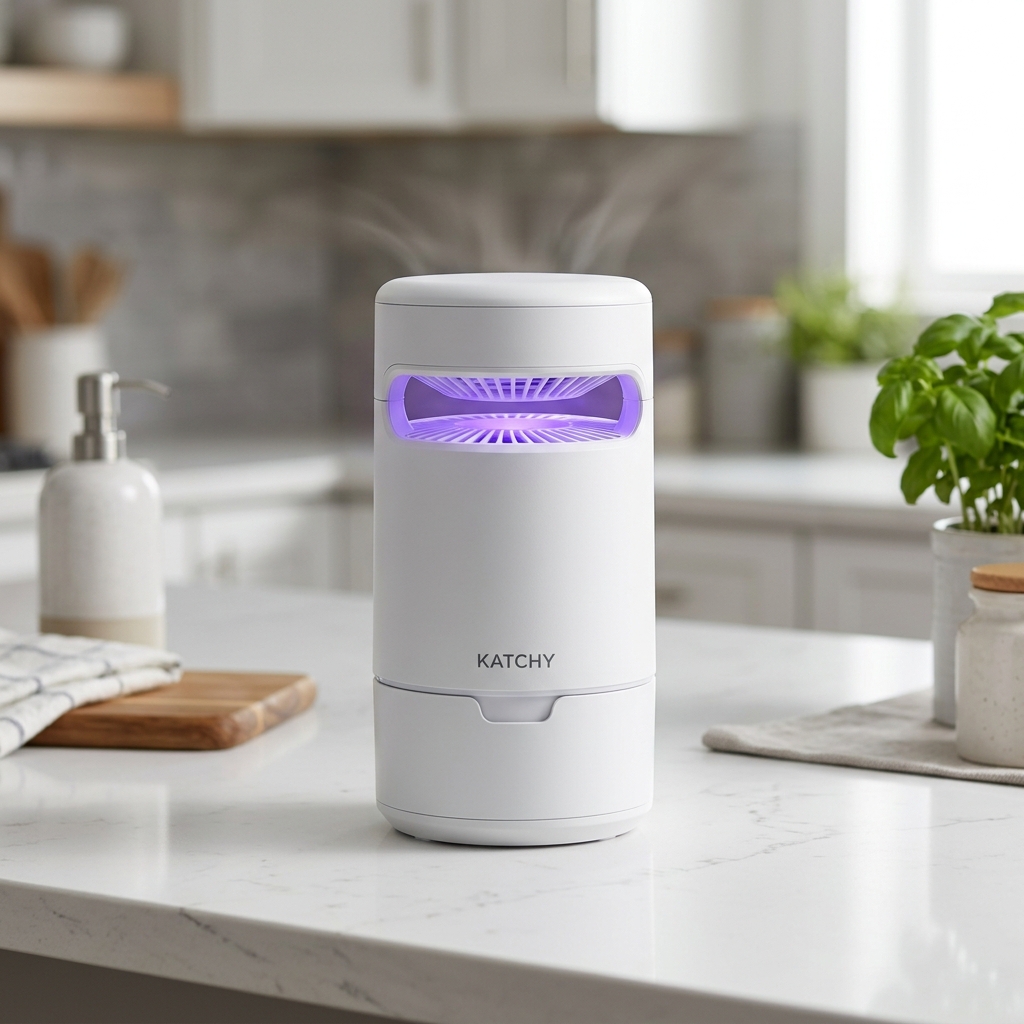
Katchy Original: for small flying insects in one room
Planning range: $35–$60, plus glue boards
Consider this branded tabletop option if you want a simple fan, UV light, and glue board in one unit. The linked model is the white Original. Its brand listing provides standard and low settings and names mosquitoes among its target insects.
Buy it for: a room where you can keep the intake clear, run it in darker conditions, and check what lands on the board. The low setting gives you a choice for fan operation.
Skip it for: a guarantee of fewer bites, a whole-home fix, or a bedroom where any light or motor sound is a problem. It is not a house-fly solution.
No electric zapping grid, simple controls, and a replaceable catch board. You can inspect the catch instead of guessing what insects are present.
It needs power, clear space, and more boards over time. A low fan setting is not a measured noise rating. We would not pay extra based on an unsupported room-coverage claim.
See the Katchy Original product page for the format and upkeep. Before checkout, confirm the model and included supplies: Original, Auto, Duo, and Pro names can appear on the same Amazon listing. The selected variant matters.
Budget ranges are for planning, not live prices. Choose it for its controls and cleanup, not a promise of bite-free sleep.
Size the plan by rooms and doors
A 200-square-foot bedroom and a 600-square-foot open living area are different layouts. Neither number tells you how many mosquitoes will reach a trap. For the Katchy Original, do not treat third-party square-foot claims as a guaranteed capture range.
Check the window and doorway first. If you still want a trap, start with one unit in that room. Decide where it can sit without lighting your face or crowding the bedside table.
Mark where you see insects, where you sleep, and where outlets are. Do not buy two units just because the floor area doubles. Try a useful location and check the result before expanding.
Do not expect a hallway trap to serve both rooms. Treat each room as its own placement decision. First look for a shared entry problem that costs less to fix.
Choose a dry, stable place that does not need permanent mounting. Report damaged screens to the owner. Check power compatibility, especially when traveling.
These room sizes are planning examples, not product coverage specifications.
Pay for the full setup, not just the device
For one room, plan around $45–$85 for a fan trap and a spare pack of boards. That combines a $35–$60 device allowance with $10–$25 for refills. Check actual pack sizes and delivered prices before deciding. A bundle is only useful if the boards fit your exact model.
If your budget is under $25, put it toward the entry problem first or use a swatter you already own for a visible insect. Do not buy a no-name light or sound gadget just to fill the budget. For two rooms, allow for two sets of upkeep only after the first setup proves useful to you.
To compare refill packs, divide the delivered pack cost by its board count. Then multiply by the number of boards you expect to use. Check them regularly before assuming a fixed monthly schedule. Dust and catch volume can change when they need replacement.
Power cost depends on the device label and your rate. Use this estimate: watts ÷ 1,000 × hours used × electricity price per kWh. A hypothetical 5-watt device used 12 hours a day for 30 days uses 1.8 kWh. That is a math example, not a Katchy power specification.
Set it up without spoiling your sleep
- Pick a place you can keep. Use a dry, stable surface near an outlet. Keep it clear of curtains, bedding, and foot traffic. Follow the exact model instructions.
- Prepare the catch surface. Remove the board's protective film as directed. Fit it correctly and keep the air intake open.
- Check light and sound from bed. Try the available settings. Do not drape a towel over the unit to hide its glow. Pick another location if it keeps you awake.
- Check the catch and the problem. Note the insects you see, whether new mosquitoes still enter, and whether the setup is worth keeping. Review it while you can still use the seller's return policy.
Dark operation is part of the Katchy Original's listed use advice. It is not proof of protection while you sleep. Keep the included instructions, unplug before cleaning as directed, and replace used boards instead of trying to wash them.
Why a full trap may not solve the bites
Small flies around plants may be fungus gnats. They can look like mosquitoes, but their source may be damp potting mix. Identify them before choosing another treatment.
A trap cannot make up for an open door or a torn screen. A steady catch may mean the entry route is still active.
A covered intake, forgotten glue-board liner, full board, or disconnected power can defeat the device. Check these before spending more.
A device that collects insects is not a net around the bed. Decide whether you want to inspect pests, catch occasional visitors, or protect a sleeper. Those goals can need different tools.
University of Maryland Extension explains fungus-gnat identification and source control. If your problem is larvae in water outdoors, use the separate dunks vs. bits guide. Do not add standing water to a bedroom as a DIY lure.
Indoor use, children, and pets
Keep cords and glue boards out of reach of children and pets. Place the trap where it cannot fall into a sink or be pulled onto a bed. A fan trap without an insecticide spray still needs proper handling. Choose an intact device with readable instructions and the right power supply.
Do not run an outdoor Thermacell repeller in a bedroom, tent, or enclosed RV. Thermacell specifies outdoor use only. Opening a window does not change that rule. Keep outdoor fuel-burning equipment outside too.
A light-and-glue plug-in is also different from a plug-in that releases pesticide. Read the product type, allowed room use, and precautions before buying. EPA explains that an establishment number is not product approval or proof that it reviewed a device's performance.
When another purchase makes more sense
For a sleeping space without screens: consider a properly fitted mosquito net. Check its dimensions against the bed and its hanging points. CDC advises a net long enough to tuck under the mattress. Keep skin away from the mesh, check for tears, and follow child-safety and fire precautions. Skip a loose decorative canopy that leaves gaps.
For one insect you can see: a plain swatter may be enough. If comparing electric handheld tools, the racket product page explains that format. It needs an awake operator and does not protect an empty room.
For continued indoor mosquitoes: CDC describes indoor-labeled insecticides or professional help after entry and water checks. Read the allowed sites, preparation, and re-entry rules for the exact product. An outdoor yard spray is not a substitute.
For a silent sound-based plug-in: we would skip it. EPA says it lacks data showing whether sound-wave devices work against mosquitoes.
For bites outside as well: use the skin-repellent comparison for moving around, or the large-yard trap guide for outdoor trapping costs. A bedroom device cannot do either job.
For overnight protection, our bed net buying guide compares mattress fit, hanging points, treated mesh, and packed size.
For the windows at home, our window screen buying guide compares mesh, frame fit, spline, airflow, and repair costs.
Mosquitoes getting in around the air conditioner? Our window AC sealing guide compares foam strips, side panels, fit, and safe placement.
Shopping for indoor sticky pads? Our glue-board refill buying guide compares original and generic parts, exact model fit, and repeat costs.
Seeing a gap under the closed exterior door? Our brush versus rubber door sweep guide covers fit, mounting choices, and repair budgets before you add another trap or screen.
Need a complete window screen? Our adjustable versus custom window screen guide compares temporary inserts and fitted frames, with measuring checks, planning budgets, and everyday-use limits.
Upgrading a window barrier? Compare high-visibility and standard mosquito screens by view, frame fit, roll size, and full project cost before buying mesh.
Still choosing the device? Compare Zevo and Katchy for mosquitoes by placement, refill budget, and the limits of light traps.
Considering one device for air cleaning and insect capture? Our air purifier versus mosquito trap guide compares separate and combined units, room size, noise, refills, and the limits of each job.
Seeing fuzzy flies near a sink or shower? Our drain flies versus mosquitoes buying guide explains when to choose cleaning tools, drain gel, adult capture, or plumbing help.
More questions before you buy
What is the best type of mosquito trap for a bedroom?
If you want a trap, start with an indoor fan-and-glue model with easy-to-find refills and a low setting. It avoids the snap of an electric grid. Fix entry gaps first, and skip a light trap if its glow or fan would disturb your sleep.
Will an indoor trap stop bites tonight?
Do not count on it. A trap catches insects that reach it; it does not put a barrier around your bed. For an unscreened sleeping space, consider a properly fitted mosquito net and follow local bite-prevention advice.
Does Katchy work on mosquitoes or only gnats?
The Original listing names mosquitoes, fruit flies, gnats, and small moths. It does not establish a guaranteed reduction in bedroom bites. Check what it catches: a board full of small flies is not proof that the mosquitoes biting you are gone.
How many traps do I need for a 200-square-foot bedroom?
Start by finding the entry point and checking the exact model instructions. There is no verified square-foot guarantee for the Katchy Original in this guide. Try one unit in the affected room before buying more, and keep a clear path to its intake.
Can one trap cover a whole apartment?
Do not assume so. A bedroom behind a closed door is a separate space from the living room. Map where you see insects and fix shared entry points first. More units mean more light, outlets, cleaning, and refills.
Should I put the trap beside my pillow?
Choose a stable, dry spot allowed by the instructions, away from bedding and within reach of an outlet. Keep the intake clear. If the glow or fan bothers you from bed, change the placement or choose another approach.
Must the room be dark for a UV trap to work?
The Katchy Original listing advises turning off room lights for best results. That does not mean a dark room guarantees mosquito capture. Do not cover the trap to hide its light, since that can block the intake.
Can I leave an indoor trap on all night?
Check the model instructions and power setup. Use the supplied or specified power supply, keep the unit dry and uncovered, and route cords away from bedding. A USB lead does not mean the trap has a battery or can run without power.
How much should I budget for a bedroom trap?
Use $35–$60 as a planning range for one branded fan-and-glue trap, then set aside $10–$25 for refills. These are budget allowances, not live offers. Check the selected model, included boards, delivery cost, and return terms before paying.
How often should I change the glue board?
Inspect it on a regular schedule and follow the instructions for your trap. Replace it when full or no longer sticky as directed. Dust and insect load vary, so do not assume every board lasts exactly one month.
Is an indoor trap safe around children and cats?
Keep the device, cord, and spare glue boards out of reach. A trap without a spray still has electrical parts and sticky surfaces. Avoid broad safety promises, and follow the exact model instructions for placement and cleaning.
Does an EPA establishment number mean the trap is approved?
No. The number identifies the place where a device was made. It does not mean EPA has approved the trap or reviewed its safety and effectiveness. A device is different from an EPA-registered pesticide product.
Can I run a Thermacell repeller in my bedroom?
No. Thermacell says its repellers are for outdoor use and must not be used in enclosed spaces. A small room or an open window does not make a bedroom an outdoor site.
Are tiny flies near houseplants mosquitoes?
They may be fungus gnats, which can look like small mosquitoes. Identify the pest before buying more traps. A flying-insect trap may catch adults while the source in damp potting mix remains.
Is an ultrasonic plug-in a better choice for sleep?
We would skip it for mosquito protection. EPA says it does not have safety or effectiveness data for sound-based repellent devices and does not know whether they work against mosquitoes. Quiet operation alone is not a reason to buy.
What should I do if mosquitoes keep coming back?
Check screens, door gaps, and water sources again. If you rent, report damaged screens or shared building problems to the manager. For an ongoing indoor problem, seek local mosquito-control or pest-control help instead of adding trap after trap.
Start with one room and one clear goal
Find the entry route, decide what light and noise you can live with, and price the refills. Buy one trap only if its job fits the problem. Use the mosquito-control finder to compare the next step without turning your bedroom into a shelf of gadgets.
For a doorway that stays open, compare magnetic, retractable, and framed screen doors by fit and how reliably they close.
Working or exercising beside an open vehicle door? Our garage mosquito buying guide compares full-opening screens, car access, airflow, and workshop trap limits.
Shopping for a wall-powered device? Compare indoor liquid repellents, glue traps, and sound devices by indoor labeling, room size, voltage, refill fit, and planning costs.
Need a tool for one mosquito you can see? Read the electric mosquito swatter buying guide for rechargeable vs. battery power, grip, safe storage, and dock-mode limits.
Fixing a torn screen?
Compare screen repair tape and replacement mesh by damage, patch size, spline fit, and total cost before buying another indoor device.
Considering a room spray or bug bomb?
Compare indoor mosquito sprays and foggers for room size, pets, time away, and alternatives before buying.
For water under the house, compare sump covers, pumps, and dehumidifiers for basement mosquitoes.