Affiliate disclosure: As an Amazon Associate, we earn from qualifying purchases. This site may earn a commission when you buy through its product links.
Start portable unless the layout earns an upgrade
For one table or a small lounge area, start with a portable repeller. Consider a wired system when you use several fixed outdoor spaces often and want them ready from one control. The extra cost buys a permanent setup and less equipment to carry. It still buys you refills, cables, and a system to maintain.
Our portable pick below is the Thermacell Patio Max, for shoppers who value a charging dock and longer battery runtime. A wired plan is a separate decision: sketch your seating areas and compare a complete installed quote before choosing one.
You own the space, dine outside often, and use a table, lounge, and fire-pit area. You can reach each head for care and accept ongoing supply costs.
You rent, move chairs often, lack a suitable power source, or only sit outside now and then. Also pause if your main space is enclosed or exposed to steady wind.
Do not buy on the promise of a mosquito-free property. Start with the yard habitat audit, then use the product finder to compare tools for the places you actually use.
Three systems that do different jobs
| Option | Best fit | Main upside | Main tradeoff |
|---|---|---|---|
| Wired heated repellers | Several fixed outdoor seating areas | One installed layout; central control | Higher initial cost; several cartridges to replace |
| Portable heated repeller | One gathering area or changing plans | Easy to move and store | Charging or fuel upkeep; limited local zone |
| Automatic misting system | A separate pesticide-spray proposal | Automates nozzle spraying | Routine spraying has exposure and environmental concerns |
A wired heated system uses cables to connect a hub to repellers. It does not run liquid through a ring of spray nozzles. Thermacell’s installed-system overview shows the hub, cables, and different mounts.
Source: Thermacell: Installed-system parts and mounts
CDC does not recommend misting systems for homes or residential areas. Its concerns include routine spraying, unintended exposure, and harm to beneficial insects. That guidance is about misting; do not use it as a blanket verdict on every device with wires. See our misting-system guide for that decision.
Source: CDC: Misting systems for mosquitoes
Nor is an area repeller a capture trap. If you want to compare adult mosquito capture across a larger property, read the large-yard trap guide.
Measure seats and gaps, not just square feet
Draw the places where people sit. Mark walls, stairs, hedges, water, doors, and the route from the outlet. Then mark possible repeller positions. A large lawn between two patios may add cable length without being a place that needs protection.
A 16-by-20-foot patio has 320 square feet. A 4-by-80-foot strip has the same area. Their shapes clearly need different plans. Do not divide your total area by a box’s coverage claim and treat the result as an installation design.
As an example of scale, Thermacell advertises LIV 2.0 for up to 3,000 square feet per hub with up to ten repellers. Those are system limits, not a promise that any ten positions cover your whole yard. An L-shaped area, hedge, or separate deck level needs its own layout check.
Source: Thermacell: LIV 2.0 system design
Get three zones priced separately
- Small patio: price the main table first and compare it with one portable unit.
- Two gathering areas: show how both will be served, including the cable route between them.
- Broad pool deck or garden: ask which seats are covered, which paths are outside the plan, and how water setbacks affect placement.
Ask how the plan changes when chairs move. A head hidden behind a hedge may look tidy yet be the wrong location. Check the space at your normal sitting time so the installer can assess its breeze.
What the installed quote should include
Get the full model names and generation on paper. Current LIV pages describe both 1.5 and 2.0 equipment. Do not combine a used hub, new heads, and a refill pack just because all say LIV.
Number of heads and hubs, cable lengths, mounts, first refills, and a drawing of all positions. Ask what an extra seating zone would cost later.
Outlet suitability, cable routing, surface repairs, and access to each cartridge. Identify any electrical work that needs a separate quote.
Your own account access, manual controls, startup routine, status lights, and who receives service alerts. Do not leave with only the installer able to operate it.
Refill supply, change labor, callout fees, winter care, warranty labor, and the remedy if the agreed layout leaves gaps.
For LIV, current support calls for a 120V GFCI outdoor outlet and a 2.4 GHz network for app setup. Basic operation is available without Wi-Fi, but connected features and updates need the connection. Have this demonstrated at the final hub location.
Source: Thermacell: LIV installation, app, and model support
Ask whether installation and refill service must be done by a pro for the exact package. Put that answer and its cost in the quote. A short advertised setup time may not include a new outlet, lifting pavers, or hiding a long cable route.
For existing owners, upgrade only to solve a clear issue, such as a changed seating plan. Ask which old parts can stay and how the new refill supply works. Do not replace a working system just to match a newer app name.
Budget for every active head
These are broad U.S. planning ranges, not live prices or installation quotes. Taxes, delivery, unusual site work, and service may add to the total.
| Plan | Starting allowance | Confirm before buying |
|---|---|---|
| Premium portable setup for one area | $50–$150 | Device, supplied refill, charger, and first spare |
| Several portable units | $150–$450 | One charging and refill plan for each unit |
| Wired system project | $1,500–$4,000+ | Exact kit, labor, mounts, outlet work, and first refills |
| Ongoing wired supplies and care | Build from your hours and quote | Pack size, approved runtime, labor, and service fees |
Do the refill math before signing
Use this worksheet: heads × cartridges needed per head = total cartridges. To find cartridges per head, divide your planned running hours by the exact refill’s rated hours and round up. Then round the purchase to whole packs. Count any usable refills included with the kit before ordering more.
Illustration only: suppose five heads each run for 120 hours in a season. If a compatible cartridge were rated for 100 hours, each head would need two cartridges. That is ten cartridges; if sold in six-packs, you would need two packs, less usable stock you already own. Five heads do not share one cartridge.
Now add the quote for refill-change visits. Ask whether the seller bills per visit, per head, or as a seasonal plan. Include warm-up time in your planned use. Set an off time so an empty patio does not keep using supplies.
Compare the three-year total: hardware and installation, plus three years of supplies and care. A paid service may be convenient. It should still be clear what you are paying for. Our refill compatibility and cost guide helps with the next check.
A premium portable option before you commit
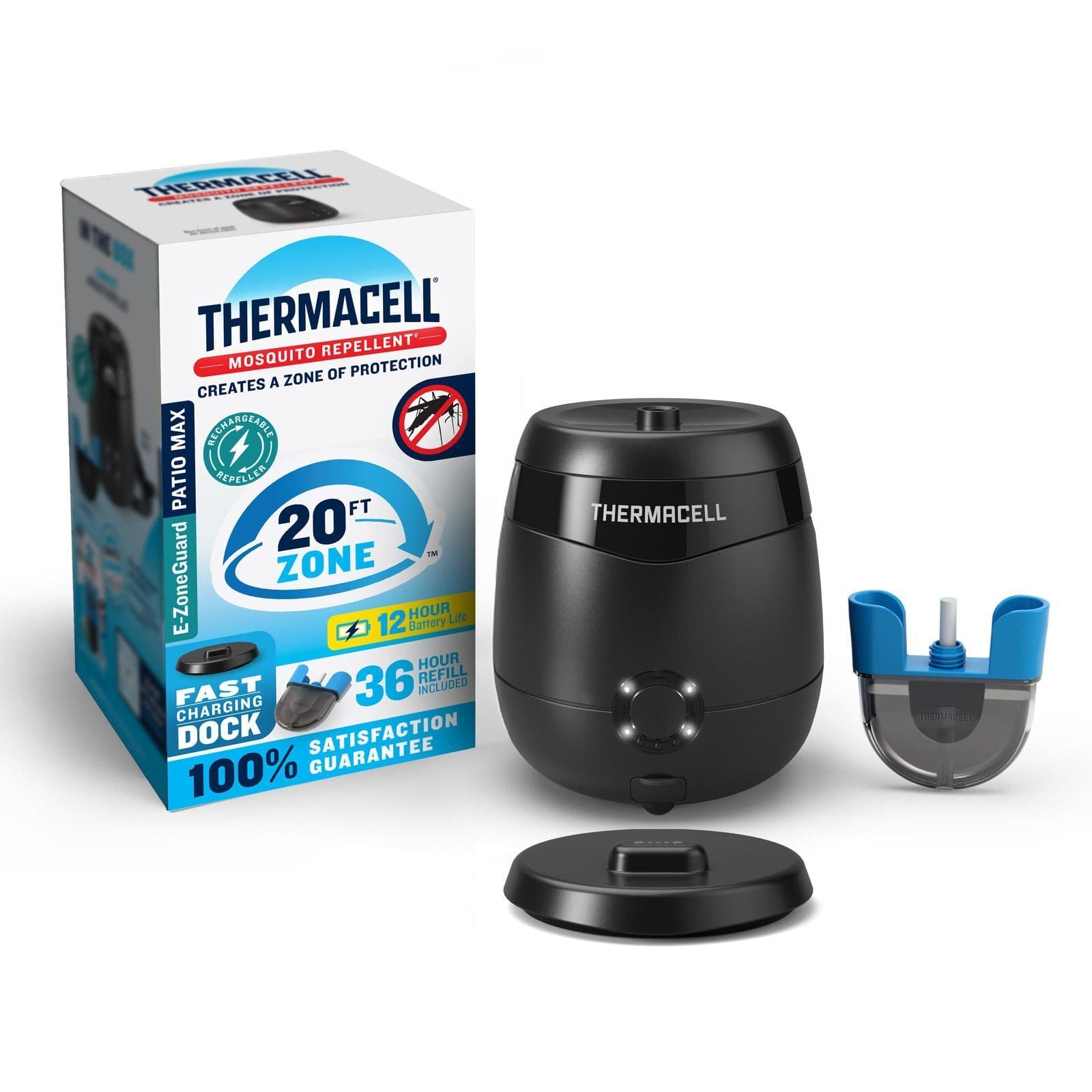
Thermacell E-ZoneGuard Patio Max
Choose it for one outdoor gathering area when you want a dock and longer battery runtime. The black kit linked here includes the charging dock and 36-hour refill. Thermacell rates the battery for up to 12 hours and the protection zone at 20 feet.
Planning allowance: $50–$100 for the device kit
You can move it when your seating changes. The dock suits frequent use without running cables around the yard.
It still needs charging and refills. It cannot promise coverage across separate seating areas, steady wind, or a whole property.
Allow the stated 15-minute startup. Use it outdoors as directed. The battery rating and included refill hours are separate limits. Read the standalone Patio Max page for the format and upkeep, or compare the portable Thermacell models.
Source: Thermacell: E-ZoneGuard Patio Max specifications
A portable unit can help you judge whether keeping a charged device ready fits your routine. It is not a test that proves a wired layout will perform the same way. You may find that protecting one table is all you need.
The E55 product page explains a smaller rechargeable format. Compare battery needs and refill fit before paying extra for runtime you will not use.
Failure conditions and care to plan for
- Wind carries the repellent away: reassess the site instead of buying more heads on guesswork.
- People sit outside the planned zone: mark the real chair positions, including overflow seats for guests.
- The system is still warming: schedule startup from the exact label, not the moment everyone sits down.
- A cartridge, power connection, or head has a fault: check the status and instructions before assuming more capacity is needed.
- Plants grow around a head: keep access and the required clearances in your garden-care plan.
Thermacell’s guidance limits these repellers to outdoor use and notes that wind can reduce their effect. Do not add one to a bedroom, closed garage, or enclosed porch.
Source: Thermacell: Outdoor use and wind limits
The May 2026 EPA LIV refill label, registration 71910-12, calls for 15 minutes to establish the zone. It also tells users to inspect refills monthly and remove and cap partly used cartridges for long storage. Follow the label supplied with your exact product.
Source: EPA: LIV refill label, registration 71910-12, May 2026
Children, pets, pools, and ponds
Keep cartridges away from children and pets. Plan mounts and cables away from play and chewing. Scent-free does not mean chemical-free. The LIV refill label says not to apply it to water and not to refill the cartridge or pour unused contents down drains. Turn the system off before changing cartridges and avoid touching the wick.
Ask the installer to confirm the exact model’s placement rules near a pool or fish pond, including flooding and splashes. Do not borrow a setback from a different portable product. If the refill is damaged, use its label and support instructions.
Source: EPA: LIV refill label, registration 71910-12, May 2026
When another purchase makes more sense
For exposed seats: compare a screened enclosure that can close all entry points. An outdoor fan may also suit the seating plan. Choose equipment rated for the place it will run.
For mosquitoes coming from your property: remove water-holding clutter and maintain water containers. CDC advises weekly emptying and scrubbing, turning over, covering, or discarding items that hold water. A wired repeller does not do that work. See the larvicide comparison for water that cannot be removed or covered and fits the label.
Source: CDC: Mosquito control at home
For walking around the yard or a local disease concern: follow public-health advice. CDC recommends EPA-registered skin repellents, suitable clothing, and screens as part of bite prevention. An installed patio system does not replace that advice. Use our skin-repellent guide to compare formats.
Source: CDC: Preventing mosquito bites
For a wider unresolved problem: compare an inspection and professional service versus DIY before adding another expensive device.
More buying questions
Is a wired mosquito repellent system worth buying?
It can be worth considering if you own the property, use several fixed outdoor areas often, and accept refill and service costs. For one small seating area or occasional use, start with a portable unit. Pay for a layout that fits your seats, not just a large coverage number.
Does permanent installation mean permanent mosquito removal?
No. Permanent describes the installed hardware. The system still needs power, refills, startup time, and upkeep. It does not remove standing water or stop new mosquitoes from arriving outside the protected area.
Is a wired repeller the same as an automatic misting system?
No. A heated repeller releases repellent from a cartridge. A misting system sprays liquid insecticide through nozzles. CDC does not recommend residential misting systems. Compare the exact method before accepting a quote for a mosquito system.
How many repellers do I need for a 500-square-foot patio?
Area alone cannot answer that. Draw the patio shape, seats, walls, and mounting points. Then apply the exact model spacing rules. A long narrow patio and a square patio of the same area can need different layouts.
Will a wired kit protect an acre of land?
Do not assume that it will. Design the system around the outdoor places people use. If your goal is wider property control, also inspect water sources and compare a separate mosquito-management plan.
Can I use a wired repeller indoors or in a closed porch?
Thermacell repellers are for outdoor use and should not be used in enclosed spaces. Do not treat a bedroom, garage, or closed sunroom as another outdoor zone. Use screens and suitable indoor control measures instead.
Does wind affect installed mosquito repellers?
Yes. Air movement can reduce the effect of an area repellent. Check the breeze at the seats during the hours you use them. More fixed heads may not solve an exposed-site problem; screens and personal protection may fit better.
Does LIV need Wi-Fi to repel mosquitoes?
Thermacell lists basic LIV operation without Wi-Fi, including repellency and status lights. App setup uses a 2.4 GHz network. Ask the installer to show manual operation and explain which connected features your exact system loses without internet.
Can I install a wired system myself?
Only if the exact system allows it and you can meet its power, cable, and mounting instructions. Confirm installation and warranty terms first. Get qualified help for outlet work and a written plan for cable routes before any digging.
Are LIV refills the same as portable Thermacell refills?
Do not assume they are. Match the refill to the exact device and generation named on its label. A shared brand name or similar-looking cartridge does not establish compatibility.
Does a six-pack give six times as many hours to the whole system?
Not when several heads run together. Each active head uses a cartridge. Work out the hours needed per head, then count cartridges and whole packs. Include any refill-change labor in the cost.
How long before guests arrive should I turn it on?
Use the startup time on the exact refill label and device instructions. For example, the May 2026 EPA label for LIV refill registration 71910-12 says to allow 15 minutes to establish the zone. Build that time into your routine.
Can I put repellers beside a pool or koi pond?
Have the installer check the exact label and model guidance before choosing those positions. The LIV refill label says not to apply it to water. Keep cartridges and spilled liquid out of the water and include flood and splash exposure in the layout.
Are wired mosquito systems safe around pets and children?
Use only as directed and keep cartridges away from children and pets. Plan mounts and cables so they cannot become playthings or chew targets. Do not treat scent-free operation as permission to touch the liquid or ignore the label.
Should I replace a working older system with the newest version?
First ask what problem the upgrade fixes. Get written compatibility for the hub, heads, cables, and refills, plus a full upgrade cost. An app name or a new generation number alone is not a reason to replace working equipment.
What should I do if I still get bites after installation?
Check power, refills, startup time, status lights, obstructions, and the actual seating layout. Ask the installer to assess gaps and wind before adding hardware. Keep using personal protection and follow local mosquito advice while the problem is addressed.
Sources and product details
Use the exact product label and installation guide when planning placement, refills, and care.
- Thermacell: LIV 2.0 system design
- Thermacell: Installed-system parts and mounts
- Thermacell: LIV installation, app, and model support
- EPA: LIV refill label, registration 71910-12, May 2026
- Thermacell: Outdoor use and wind limits
- Thermacell: E-ZoneGuard Patio Max specifications
- CDC: Misting systems for mosquitoes
- CDC: Mosquito control at home
- CDC: Preventing mosquito bites
Buy for the space you use
Start with one seating area, an honest hours estimate, and a clear refill plan. If a wired system still fits, compare complete quotes with the same layout. Use the product finder to build the rest of your mosquito plan.